
SACRAMENTO, Calif. — California has a plan for young families who can't scrape together a down payment. The state will lend them the down payment. Folks, that's like curing a hangover by ordering a bigger glass.
It's called Proposition 37, and it's on the Nov. 3 ballot. It lets the California Housing Finance Agency sell up to $25 billion in revenue bonds and turn that money into home loans, according to the state's Legislative Analyst's Office.
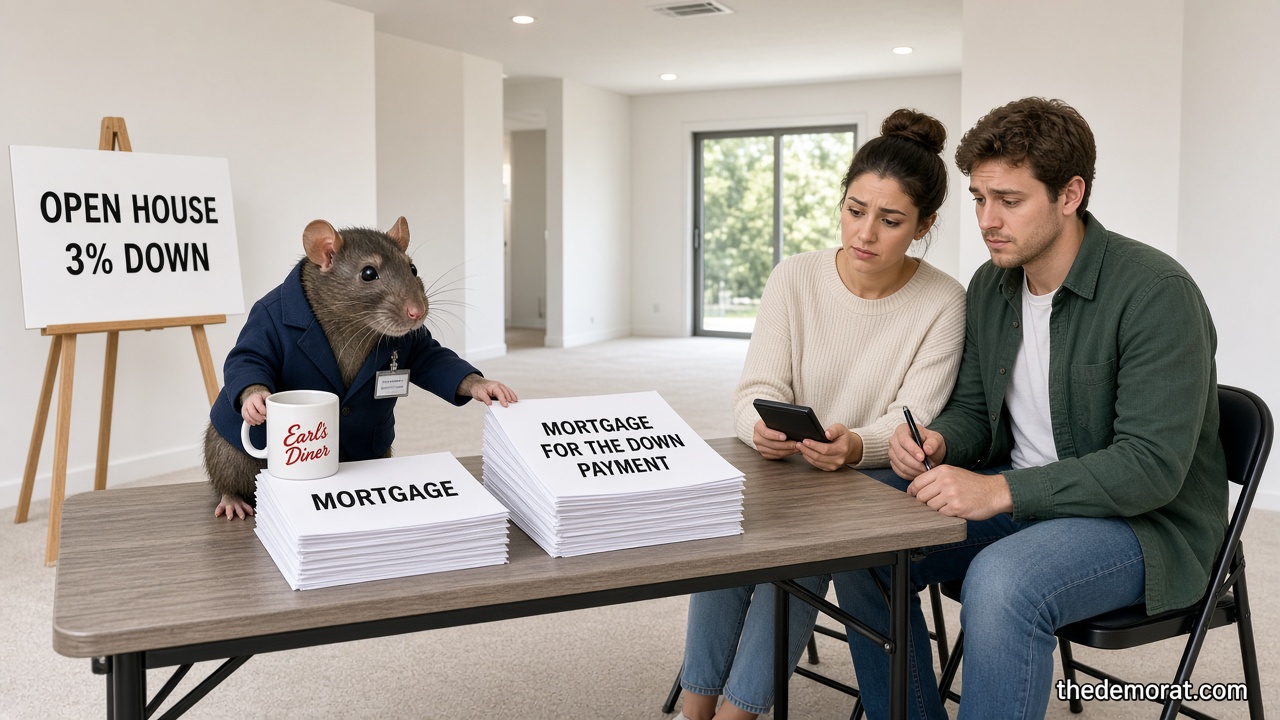
Here's how the plate comes out of the kitchen. You put down at least 3%. The state hands you a second mortgage for up to 17%. A regular bank covers the other 80%. Add it up and you've got the classic 20% down, except 17 of those points are a loan, and the loan has a monthly bill.
Back home we call that putting it on the tab. At Earl's diner, the tab tops out around eleven dollars and Earl's patience. California's tab tops out at $25 billion and nobody's patience at all.
The homes have to be newly built, and you have to be the first buyer. Household income can run up to twice the local median, and price caps land roughly between $1 million and $1.5 million depending on the county, according to the California Budget & Policy Center. That works out to as much as $170,000 to $255,000 in state-backed help per house.
So the "middle-class" program covers a $1.5 million house. In most of the country, that's not middle class. That's the guy who owns the bank.
Financial adviser Ted Jenkin ran the numbers in a Fox News op-ed. On an $800,000 home, the usual 20% down is $160,000. Under Prop 37, you could put down $24,000 and borrow $136,000 from the state program. Your first mortgage is still $640,000.
Using his illustrative rates, 6.5% on the first and 7% on the second, monthly principal and interest climbs from about $4,045 to about $4,950. That's roughly $900 more a month, before taxes, insurance or the first leak.
California's existing down payment programs, MyHome and Dream for All, use deferred loans with nothing due until you sell or refinance. Prop 37's version is likely to require monthly payments, the Budget & Policy Center says. That's the difference between a friend saying "pay me back someday" and a friend who shows up every first of the month with a clipboard.
The analyst's office says the measure has no direct state or local cost, because borrowers' payments repay the bondholders. If buyers can't pay, the private investors are supposed to eat it. CalMatters notes some analysts doubt lawmakers could resist pressure to bail people out. That's the same Capitol still paying off a 2008 train bond, promising it won't pick up the check this time.
Developers who meet higher labor standards can join a "qualified builder" option, which gives them more flexibility under construction defect rules. So the builder gets flexibility on defects, and you get a second mortgage. Everybody leaves the table with something to fix.
Supporters listed in the official voter guide include the United Nurses Associations of California, the California Conference of Carpenters and State Treasurer Fiona Ma. Under opponents, the guide says: "None submitted." Not one. In California. A state that has filed an argument against just about everything except its own tab.
California's housing hangover has a cure on the ballot: another round, on a second tab, payable every month for 30 years. Earl would at least throw in the coffee.
This article is satire. The Demorat is a parody news site; real facts are drawn from the linked sources, and jokes, invented scenes, and fictional characters are not real.
The real story that inspired this