
Americans will spend a record $13.5 billion on Halloween this year, according to the National Retail Federation. They will bring home less candy for it. That isn't the trick. That's the pricing model.
Let's open the books.
Candy and chewing gum prices rose 7.7% in the 12 months through September, according to the Bureau of Labor Statistics. Overall inflation was 3.7%. Food eaten at home rose 1.8%.
So the bag of fun-size bars in your cart is going up about four times faster than the groceries sitting next to it. "Fun-size" now describes the margin.
Go back five years and candy prices are up 44%, compared with 22.5% for food at home, according to the Associated Press. A $10 bag in 2021 is a $14.40 bag today. Nobody has reported the bag getting 44% bigger.
Here's the line item that should get an audit. Cocoa, the main ingredient in chocolate, has fallen sharply from its January 2025 peak, according to an Ohio State University agricultural economist. The International Cocoa Organization estimates the market went from a 492,000-ton shortage to a 37,000-ton surplus.
Chocolate prices have not gotten the memo. The Ohio State economist says manufacturers may still be working through cocoa contracts signed when prices were high.
When cocoa went up, the candy aisle followed it up like a golden retriever. When cocoa came down, the candy aisle entered a contractual grieving period. Grief, like chocolate, is now sold by the ounce.
Last Halloween is the audit trail. NielsenIQ found Halloween candy sales rose 7.6% in dollars in 2025 while units fell 2.5%. Chocolate's average unit price jumped 11.5%.
Dollars up. Candy down. Industry calls it a strong season. Your kid calls it "three pieces and a toothbrush."
This year, NielsenIQ found Halloween candy sales fell 6.7% in the month ending Oct. 17, the AP reported.
Now the household side. The NRF expects average Halloween spending of $115.14 per person, up from $114.45 last year. That's a 69-cent raise, against prices up 3.4%. The American family has given its Halloween budget a cost-of-living adjustment roughly the size of one Tootsie Roll.
The NRF found 31% of shoppers plan to comparison shop if prices run high, 26% will hunt for coupons and 34% will look for items they can reuse. The plastic skeleton in your garage is no longer a decoration. It's a depreciating asset.
"Consumers continue to make Halloween a spending priority, but they are also approaching the season with affordability in mind," said NRF Vice President Allison Zeller.
With affordability in mind. Not in the wallet. In the mind, the one place prices haven't reached yet.
The National Confectioners Association says candy makers and retailers offer seasonal promotions and "different package sizes" to give shoppers options at various price points. Accountants have a technical term for "different package sizes." It's "smaller."
Ninety-six percent of Halloween shoppers still plan to buy candy, according to the NRF. The other 4% will turn off the porch light, sit in the dark and call it a budget.
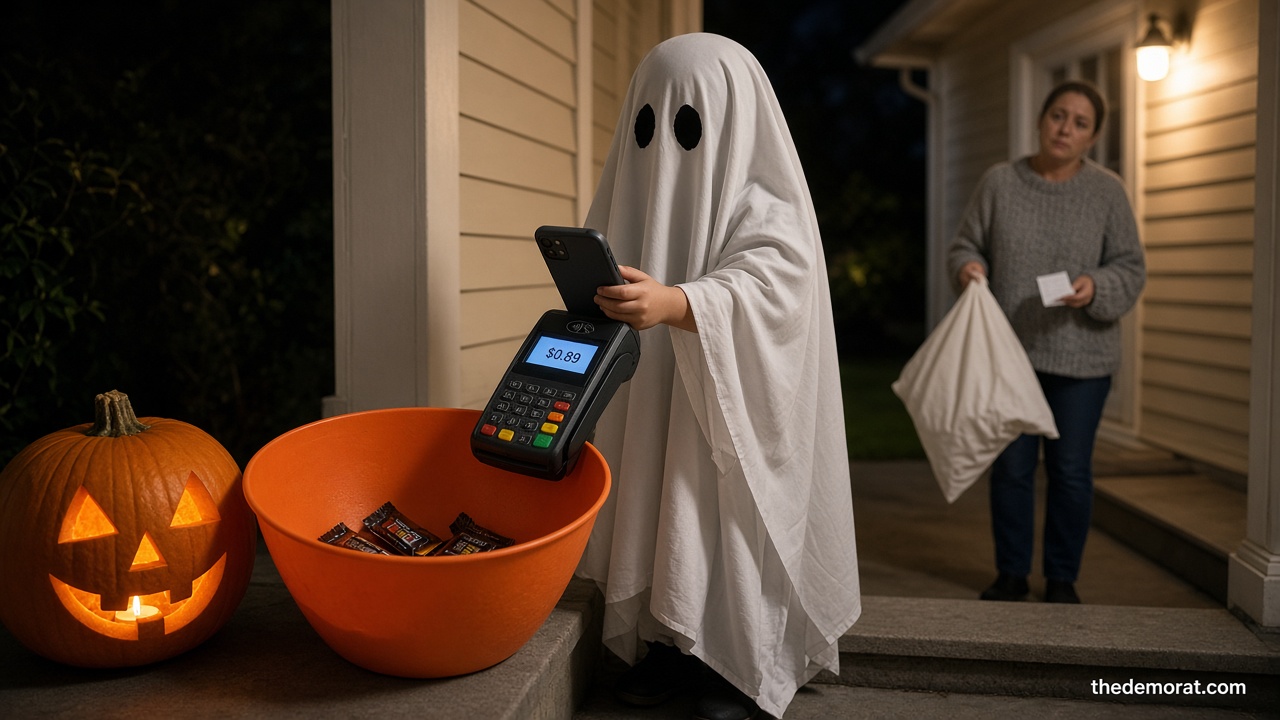
Meanwhile, $4.1 billion goes to candy alone. That's enough to make every porch in America look generous from the sidewalk and stingy from the bowl.
So yes, a record $13.5 billion. Record spending, fewer pieces, same doorbell. The kids will still ring it and say "trick or treat." At these prices, the candy aisle already picked trick.
This article is satire. The Demorat is a parody news site; real facts are drawn from the linked sources, and jokes, invented scenes, and fictional characters are not real.
The real story that inspired this