
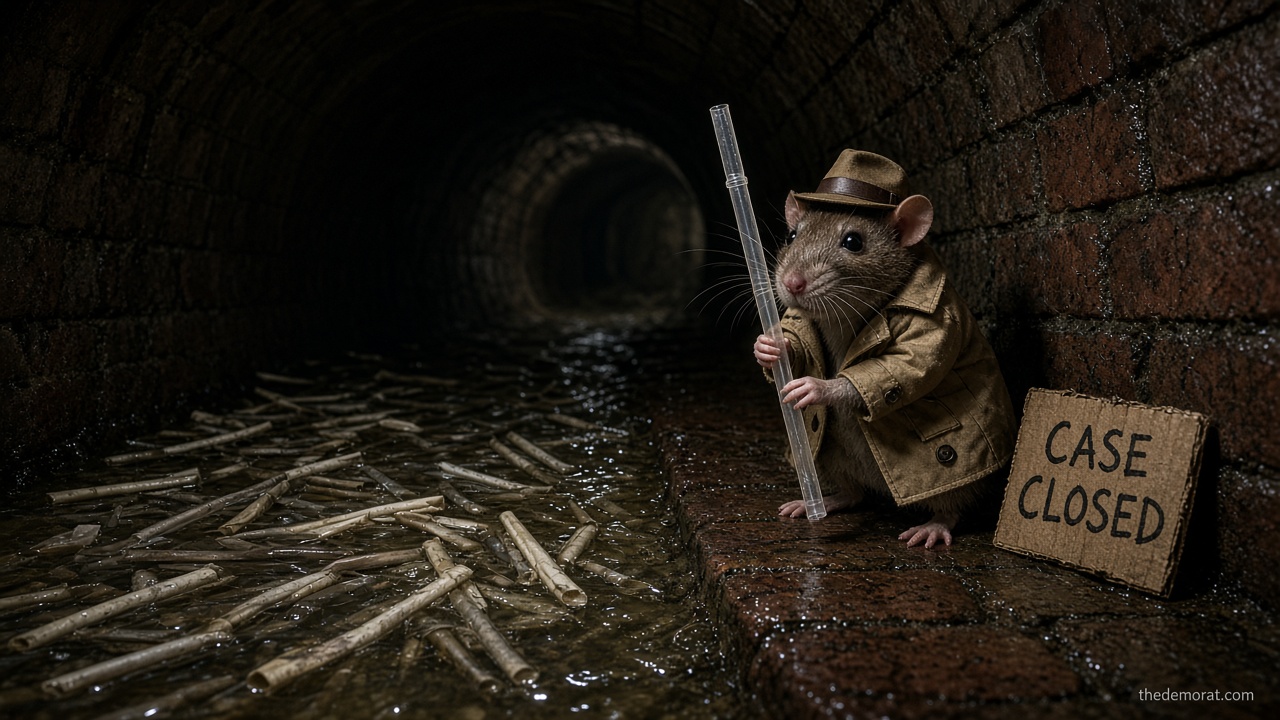
Some cases go cold. This one went soggy.
For years, the rats in my tunnel have been finding the evidence. Paper straws, bent in half, floating past like little drowned flags of surrender. Nobody down here ever asked what they were surrendering to. Now we know: plastic.
A study from South Korea's Ministry of Climate, Energy and Environment compared four kinds of straws, paper, plastic, biodegradable plastic and sugarcane-based, across 16 environmental categories, the New York Post reported. Plain plastic straws had the lowest environmental footprint in 10 of the 16, including climate change impact, human toxicity and particulate matter.
Paper straws generated more than six times the carcinogens of plastic ones and double the acidification impact. The sugarcane-based "Bio-PE" straws, the ones with the most virtuous name in the lineup, scored 16 times the carcinogenic impact of regular plastic.
The virtue was decorative.
And recycling, the paper straw's last alibi, collapsed under questioning. The study found paper straws are so small they slip through sorting machines, so almost none actually get recycled. Their water-resistant coatings and glues also make them harder to break down.
So let me read the charges back. The paper straw was worse for the air, worse for the water, and worse for your latte. It failed at the one job of a straw, which is staying a straw, and the one job of an environmental product, which is helping the environment.
Two strikes. And it couldn't even hold the bat.
I've seen things down in the tunnels. I've seen a rat drag an entire hoagie through a storm drain without losing the pickle. I have never seen a policy movement spend a decade fighting a drinking straw and lose to it on points.
You remember the campaign. Seattle banned plastic straws in 2018. California started making restaurants hold them back until you asked, like contraband. Coffee chains rolled out sippy-cup lids for grown adults. And every one of us learned the same lesson: the last third of any iced drink is a race against the straw dissolving into wet cardboard pulp in your mouth.
That was the price of saving the planet. We paid it in mushy little installments.
It turns out the planet didn't want the payment.
South Korean lawmaker Kim Wi-sang said the government "must acknowledge the failure of its greenwashing policy, which fixated on ineffective substitute materials." A government survey of 1,001 South Koreans found 87.5% dislike paper straws, which means the other 12.5% either never used one or sell them.
Here's the uncomfortable truth the straw crusade never wanted on the menu. A good share of the movement was never about measuring the damage. It was about feeling clean at the register. The paper straw was a moral accessory you could throw away, and it was never even going to make it to the recycling plant.
Meanwhile, the activists who spent ten years calling plastic straws an emergency are now facing a study from a climate ministry, not an oil company, saying the emergency was the replacement.
I expect a statement any day now. It will be printed on recycled paper, and it will be too soggy to read by the end.
Case closed. The rats are keeping the plastic ones. They hold up better in the water, which, for the record, is where every one of these straws ended up anyway.
The Demorat is satire. This article is a parody based on real news reports and is not meant to be taken as literal fact.
The real story that inspired this